In recent years, a tragic story has gripped the Canadian public and echoed around the world: allegations of mass graves filled with the remains of Indigenous children at Canadian Residential Schools. They were secretly murdered or disposed of at residential schools run by Christian and Roman Catholic churches. Even many well-meaning Christians and churches believed the stories and felt tremendous guilt and shame for such an attrocity. This narrative, amplified by media headlines, politicians, and schools, paints a picture of deliberate genocide, with thousands of young lives “taken” in a systematic campaign of horror. Flags flew at half-mast for months, churches were vandalized and burned, the crowds donned their orange shirts in support as millions of dollars flowed into investigations and indiginous reparation programss.
Yet, as we peel back the layers with careful scrutiny, a different picture emerges—one of exaggeration, misinformation, and, in many respects, a deliberate hoax.
This is not to deny the real abuses and tragedies that occurred in the residential school system, where neglect, disease, and cultural ignorance inflicted deep wounds on Indigenous communities. But, as we will see in this article, the specific claim of “mass graves” of murdered children lacks evidentiary support, distorts history and hinders true reconciliation.
So, why dig into this? (Pardon the pun)
Because truth matters in real reconciliation, and Christians should care about that. Furthermore, I believe this is yet another example of the rotten woke ideology of social justice that has infected Canadian culture and even churches.
The Biblical Importance of Truth in Justice
The Bible is very concerned with truth when it comes to issues of justice. Jesus calls himself the “truth”. God is interested in what is actually true, not what we feel is true, or in relativistic truth. He abhors inequal weights and measures in judgments. He expects us to thoroughly examine a case and hear both sides of an argument before making a judgment. This is clear throughout Scripture:
- “You shall not bear false witness against your neighbour.” Exodus 20:16
- “Keep far from a false charge, and do not kill the innocent and righteous, for I will not acquit the wicked.” Exodus 23:7
- “You shall do no wrong in judgment, in measures of length or weight or quantity.” Leviticus 19:35
- “A single witness shall not suffice against a person for any crime or for any wrong in connection with any offense that he has committed. Only on the evidence of two witnesses or of three witnesses shall a charge be established.” Deuteronomy 19:15 (cf. 2 Cor. 13:1 & Matt. 18:16)
- “You shall not pervert justice. You shall not show partiality, and you shall not accept a bribe, for a bribe blinds the eyes of the wise and subverts the cause of the righteous. Justice, and only justice, you shall follow, that you may live and inherit the land that the Lord your God is giving you.” Deuteronomy 16:19-20
- “If one gives an answer before he hears, it is his folly and shame.” Proverbs 18:13
- “The one who states his case first seems right, until the other comes and examines him.” Proverbs 18:17
- “A false witness will not go unpunished, and he who breathes out lies will perish.” Proverbs 19:9
- “Unequal weights and unequal measures are both alike an abomination to the Lord.” Proverbs 20:10
- “These are the things that you shall do: Speak the truth to one another; render in your gates judgments that are true and make for peace.” Zechariah 8:16
I have written at length elsewhere on the important distinction between secular social justice and true biblical justice. So, as Christians, we must be concerned with truth at all times, and especially in a case like this—where the allegations of “mass graves” and “genocide” are very serious matters.
Every Lie Matters
Oftentimes, there is a cost to speaking the truth in our age. The narrative surrounding the Canadian Residential Schools is no exception. You’ll be called every name in the book for daring to challenge the narrative.
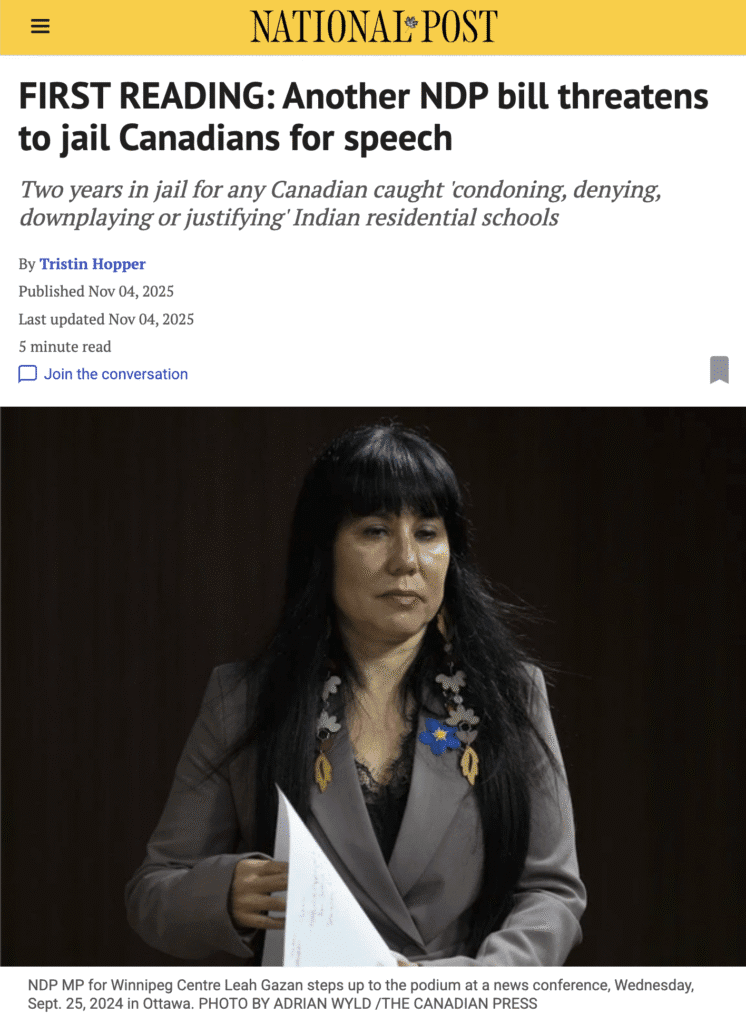
Recently, a Canadian MP has proposed a bill that would jail any Canadian questioning the offical narrative. This would functionally prevent any sort of investigation as to the truth of these claims by silencing anyone who dares to dig deeper. (So, if this article or website disappears in the future—you know why)
Now, if the narrative is true, then why should we be afraid to look for evidence? Truth, if it is true, can stand up to questioning.
As followers of Christ, we are called to love truth, for God Himself is truth (John 14:6), and bearing false witness against our neighbour violates the ninth commandment (Exodus 20:16).
C2C Journal notes that,
The most dangerous myths are those everyone claims to be true. Set in motion by the evidence-free “discovery” of 215 unmarked graves at the former Kamloops Indian Residential School, Canada’s myth of the missing children has come to dominate native discourse at home and abroad. And anyone who asks for proof of this tale of officially-sanctioned mass murder is now labelled a “denialist.”
False narratives, as Dr. Carl Trueman notes in his article on fallacious history, often arise from cultural pressures that prioritize sensationalism over facts, leading to a distorted view of the past that serves present agendas. He advises that we ask:
What evidence is being cited? Indeed, is evidence being cited? What kind is it? Is it eyewitness testimony? Is it a written document? And is the evidence capable of sustaining the narrative being offered?
These are great questions for us to ask when evaluating a historical claim.
This article builds a cumulative case: the “mass graves” narrative is unfounded, ideologically driven, benefits specific actors, and has caused profound harm. We will trace its history, present the evidence against it, analyze its origins and beneficiaries, explore its negative impacts, and address common objections along the way to forge an air-tight argument.
The History of the Narrative of Canadian Residential Schools
The residential school system in Canada operated from the 1870s to the 1990s, funded by the government and administered primarily by Christian denominations such as the Catholic, Anglican, and United Churches. The goal was assimilation—educating Indigenous children in Euro-Canadian ways to integrate them into broader society. While this policy inflicted some cultural harm, often separating children from families and suppressing languages and traditions, pre-1990s media coverage frequently highlighted positive aspects, such as education and success stories. In fact, many alumni rose to prominence as politicians and professionals.
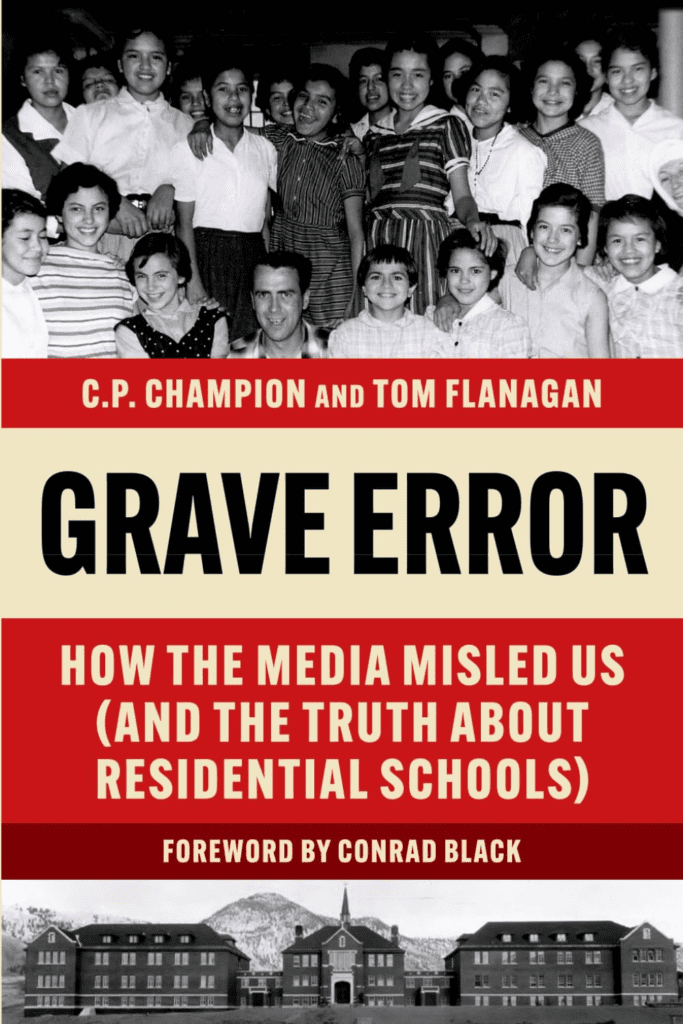
While many claim that the schools were forced upon the Indigenous communities, attendance often required parental consent through application forms, with some schools even having waiting lists, suggesting voluntary participation in numerous cases (see Grave Error: How the Media Misled Us (and the Truth about Residential Schools).
The Shift in the Narrative
The narrative shifted dramatically in the 1990s. Phil Fontaine, former chief of the Assembly of First Nations, alleged sexual abuse at his school in a 1990 CBC interview, sparking a wave of claims and lawsuits. This culminated in a 2005 government settlement of $5 billion to about 80,000 claimants. In 2008, Prime Minister Stephen Harper issued an apology, describing the schools as a “sad chapter” in history (see Flanagan & Champion, 2023, p. 22-25).
The Truth and Reconciliation Commission (TRC), established in 2008, held hearings where testimonies were collected without fact-checking or cross-examination.
Its 2015 report termed the system “cultural genocide”—a metaphorical description of assimilation efforts—and estimated thousands of deaths, primarily from diseases like tuberculosis.
However, the TRC did not claim mass murders or secret graves; it identified 3,200 named deaths, with potential for unnamed ones, but failed to thoroughly cross-reference historical documents, fostering myths of “missing children”. For sources on that you can check out Canada’s Residential Schools: Missing Children and Unmarked Burials.
The Myth Ignited
Fringe elements planted seeds for the hoax earlier.
Terry Glavin writes, in an article entitlted “Canada slowly acknowledging there never was a ‘mass grave'” that,
Just where the stories about secret nighttime burials in the orchard came from is also shrouded in contradiction and conspiracy theory. The stories first came to public attention around 2006, when the defrocked liberal United Church Minister Kevin Annett was in Kamloops with tall tales about Queen Elizabeth taking children from the Kamloops Indian Residential School on a picnic, and the children were never seen again.
This groundwork fertilized the soil for mainstream eruption in 2021.
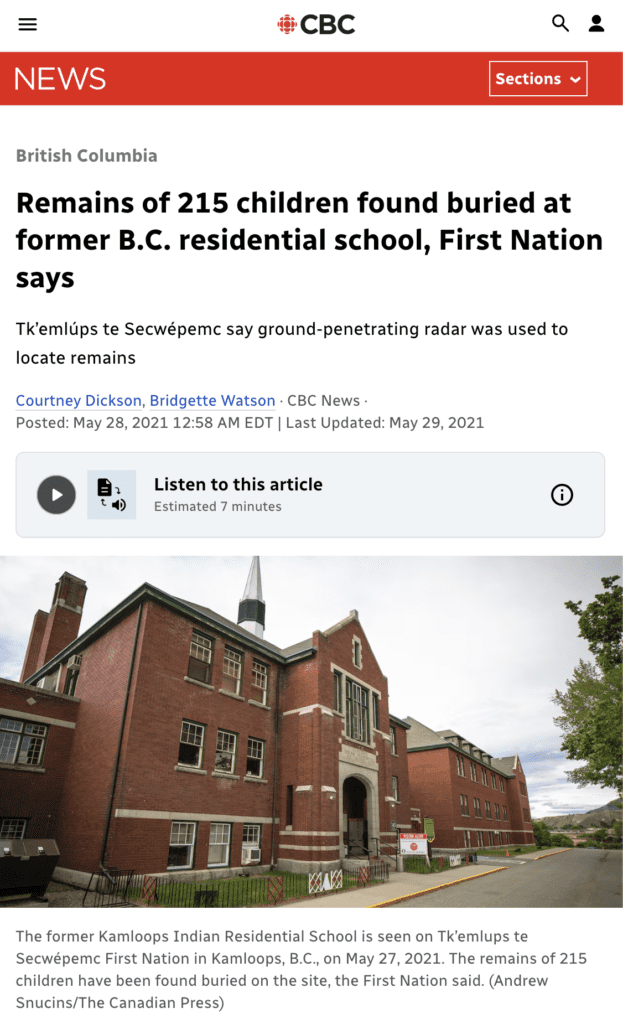
On May 27, the Tk’emlúps te Secwépemc First Nation announced ground-penetrating radar (GPR) had detected 215 “anomalies”—soil disturbances—at the former Kamloops Indian Residential School, interpreted as unmarked graves of “missing children.” The Canadian propaganda machine of the CBC jumped on the opportunity in their article, claiming that the remains of 215 children were found in the residential school. However, as the Fraser Institute notes, Chief Rosanne Casimir’s press release avoided terms like “mass graves” or murders, suggesting possible remains.
The firestorm had ignited, and the mainstream media sensationalized it. The New York Times labelled it a “mass grave,” Canadian outlets called it the “news story of the year,” and Prime Minister Justin Trudeau ordered flags at half-mast for “215 children whose lives were taken.” Similar announcements followed, like 751 anomalies at Marieval, Saskatchewan, yet no excavations were done to confirm bodies.
C2C Journal recounts that,
The discovery of the so-called unmarked graves was subsequently chosen by Canadian newspaper editors as the “news story of the year.” And the World Press Photo of the Year award went to “a haunting image of red dresses hung on crosses along a roadside, with a rainbow in the background, commemorating children who died at a residential school created to assimilate Indigenous children in Canada.” It appears to have been the single most important thing to happen in Canada in 2021.
By 2022, the House of Commons unanimously declared the schools “genocidal,” led by NDP MP Leah Gazan. Critics were branded “denialists,” with calls to criminalize skepticism.
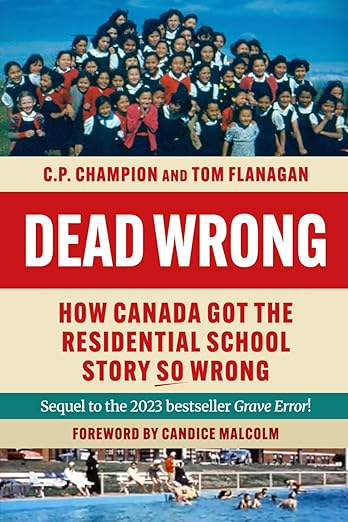
The myth had now been firmly established in the popular culture. By 2024, the so-called documentary Sugarcane was nominated for an Oscar even though it was riddled with errors about St. Joseph’s Residential School at Williams Lake, BC—as documented in the follow-up book by Champion and Flanagan, Dead Wrong: How Canada Got the Residential School Story So Wrong.
The Hoax: No Bodies, No Graves, Just Anomalies
Critics label this a hoax because, despite bold claims, no bodies have been exhumed, Ground Penetrating Radar (GPR) anomalies do not prove graves, and the term “mass graves” implies clandestine murders unsupported by the evidence. As of August 2023, 20 GPR anomaly announcements occurred, but no excavations at Kamloops or most sites. Where digs happened, like Pine Creek, Manitoba, only artifacts such as animal bones or old tiles were found—no human remains linked to schools.
The Limits of GPR Technology & Forensics
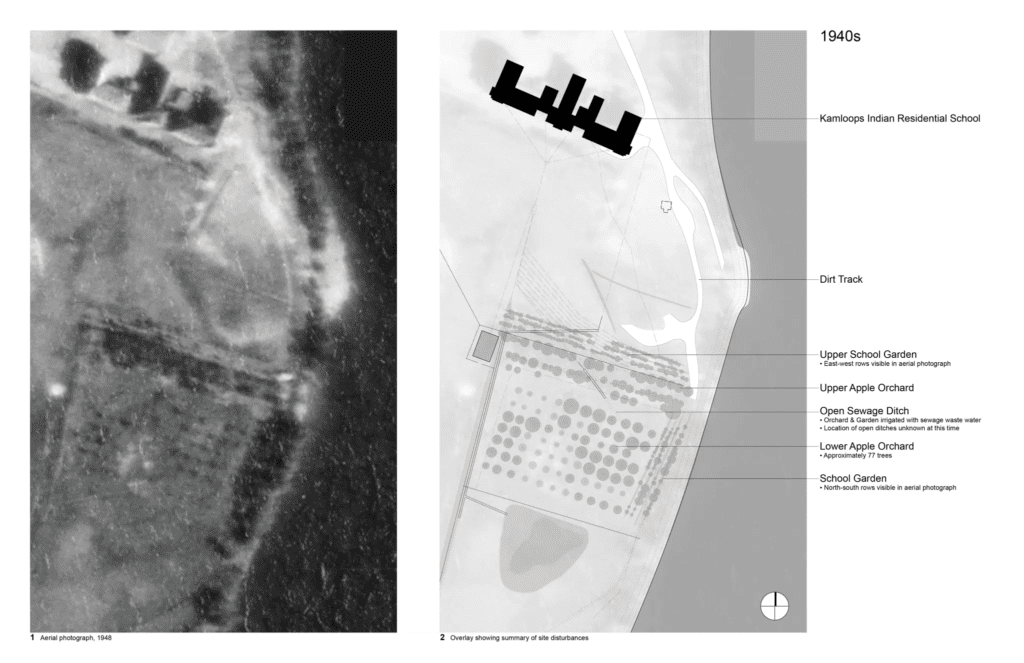
Perhaps part of the confusion lies in the public’s ignorance about the limitations of GPR technology. GPR detects soil disturbances. It cannot reliably distinguish between buried bodies or buried tiles. At Kamloops, for example, the anomalies may trace to 1924 sewage tiles. Graves in the Orchard has compiled a lot of info regarding this as well as the Indian Residential Schools Research Group. Due to the limitations of GPR technology, excavation is required for confirmation. Peer-reviewed work, such as “Community-led investigations of unmarked graves at Indian residential schools.” in Archaeological Prospection emphasizes that GPR for graves needs forensic follow-up.
The truth is, there are no “missing children” in the sinister sense. The TRC’s “missing” tag stemmed from inadequate record cross-referencing. Historical documents, like Indian Affairs reports, tracked most students’ fates—deaths were recorded, often from disease. Being “forgotten” by families over generations does not equal “missing” due to murder.
The book Grave Error compiles essays from retired judges, professors, and journalists (e.g., Tom Flanagan, University of Calgary; Hymie Rubenstein, anthropologist), using records, GPR analyses, and accounts to debunk claims.
As Cory Morgan writes in the Epoch Times,
“It’s absurd that people can claim a site contains the bodies of hundreds of murdered children yet refuse to allow further investigation into the issue. Only when we have confirmed what did or didn’t happen in Canadian residential schools will we be able to close the door on that chapter of our national history. Until there are excavations at the Kamloops site, the myths will continue to be spun and national healing won’t happen.”
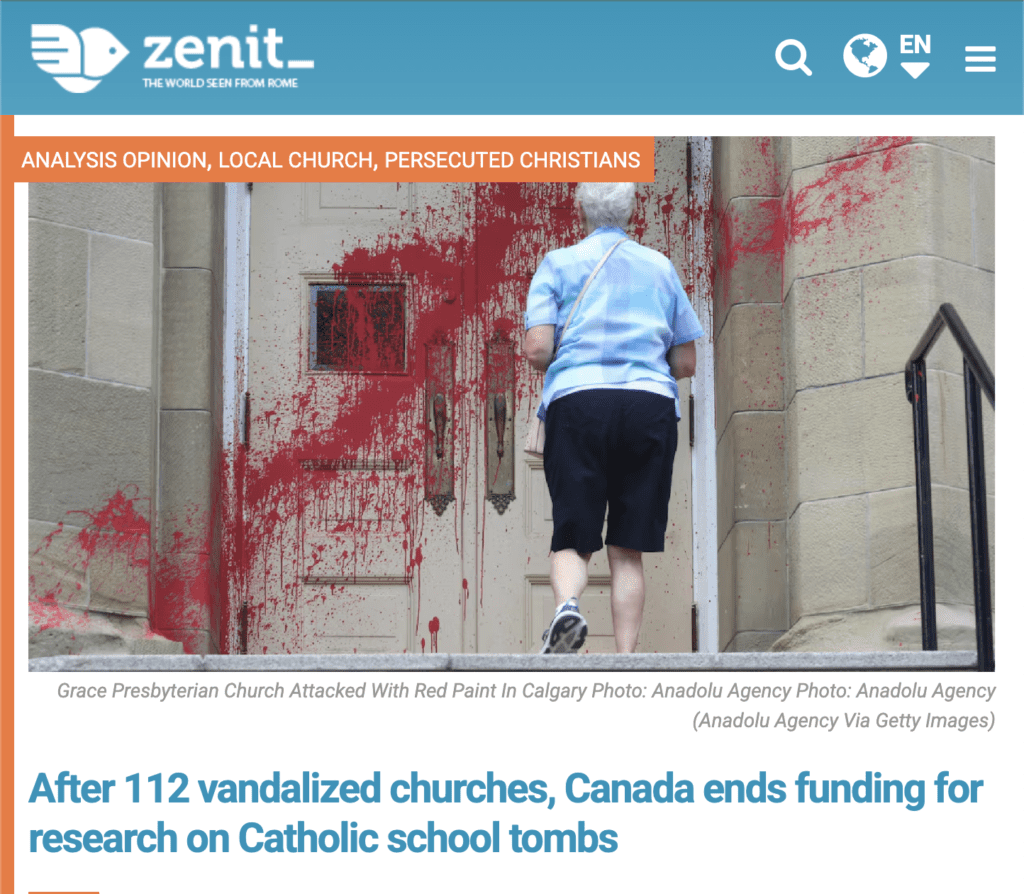
As of October 2025, there have been no excavations at Kamloops despite the 2021 announcement. A poll by the Angus Reid Institute (August 13, 2025) found 70% of Canadians demand physical proof before accepting claims. The shíshálh Nation’s 2023-2025 scans detected 40 anomalies but no digs. By March 2025, over 20 sites yielded zero bodies. One report on March 13, 2025, notes $320 million in funding with no evidence, calling it a “costly myth.” The Fraser Institute’s February 2024 commentary, updated through 2025, confirms no unmarked graves discovered despite 20 announcements by August 2023. In March 2025, the government ended funding for a key committee after fruitless searches, with one analysis labelling it a “lie” that unravelled.
Deaths from Disease, Not Murder
The Truth and Reconciliation Committee itself documented 3,200 named deaths (updated to 4,100 by 2015), mostly from tuberculosis (TB) and other diseases: 49% TB, 24% other illnesses, 4% accidents, 3% fires (TRC, 2015, Vol. 4, p. 55-60). Rates were high—25% in some western schools per Dr. Peter Bryce’s 1907 report—but comparable to reserves due to poverty and sanitation issues. Bryce blamed overcrowding, not intentional killing. You can read the scan of the Report on the Indian Schools of Manitoba and the North-West Territories from the Government of Canada here.
Meaghan Walker-Williams, a Cowichan Tribes Band member, writes in an article in the National Post,
Students at the schools died of disease at rates much higher than the general population because of poor sanitary conditions and a lack of health screening. The schools were often rife with physical and sexual abuse, on top of the fact that a deliberately assimilationist objective suppressed Indigenous culture and languages.
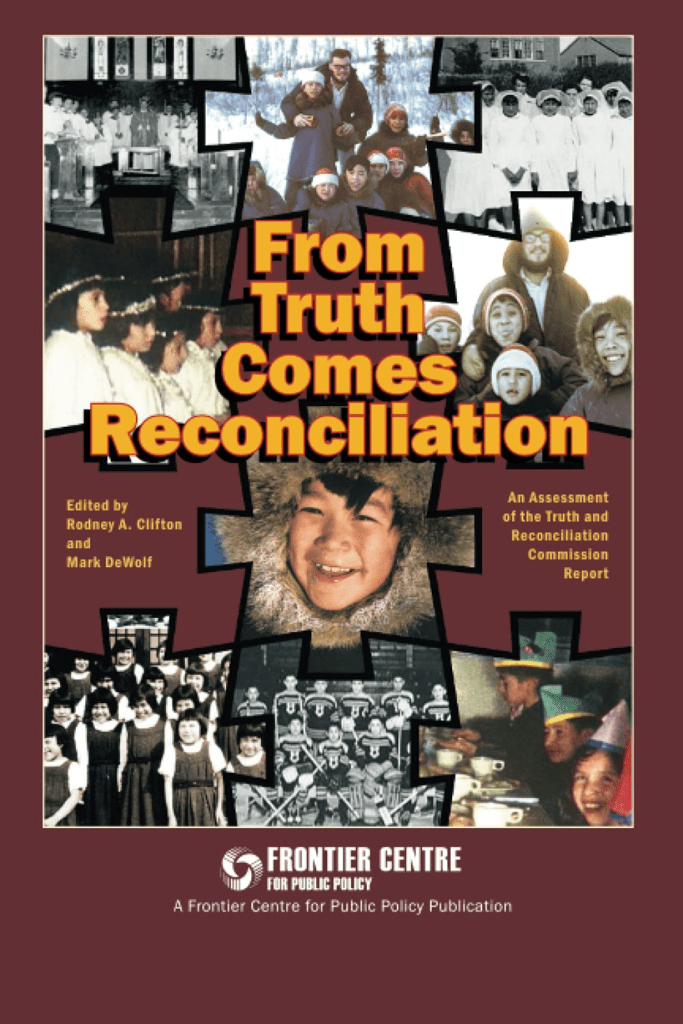
As the book From Truth Comes Reconciliation: An Assessment of the Truth and Reconciliation Report notes,
“…The TRC Report fails to place the history of IRS into the broader context of how Canadian children were treated at the time. During the IRS period, thousands of children in Great Britain resided in harsh boarding schools, thousands more were forced to live in horrific workhouses, and thousands more—the “Home Children”—were sent to Canada in what was essentially a forced migration process… Up until the 1960s, thousands of Canadian children and teens languished in hospitals, sanatoria, orphanages, reform schools, homes for unwed mothers, and mental institutions. Virtually all of these children were treated in ways that would be considered inhumane, perhaps even criminal, by today’s standards. Saying this is not to justify treating Indigenous children in an inhumane way, but simply to note that in the not-so-distant past, life was very difficult for many Canadian children…” (p. 160)
The schools were underfunded ($180/year per student in 1938 vs. $550-642 for non-Indigenous boarding schools), and malnutrition exacerbated TB, as 1940s Nutrition Division studies showed, but this was due to poor management and sometimes neglect, not genocide. So, one may legitimately make the case that there were wrongs done to indigenous peoples in the form of neglect and a lack of funding and care. However, the claim of genocide—the intentional systematic destruction of a people group—is unfounded and exaggerated.
The Ideologies & Beneficiaries Behind the Hoax
Ultimately, the ideologies behind the “mass graves” hoax are tied to Cultural Marxism or Neo-Marxism. I have written and spoken elsewhere at length about Cultural Marxism and its impact on our modern world.
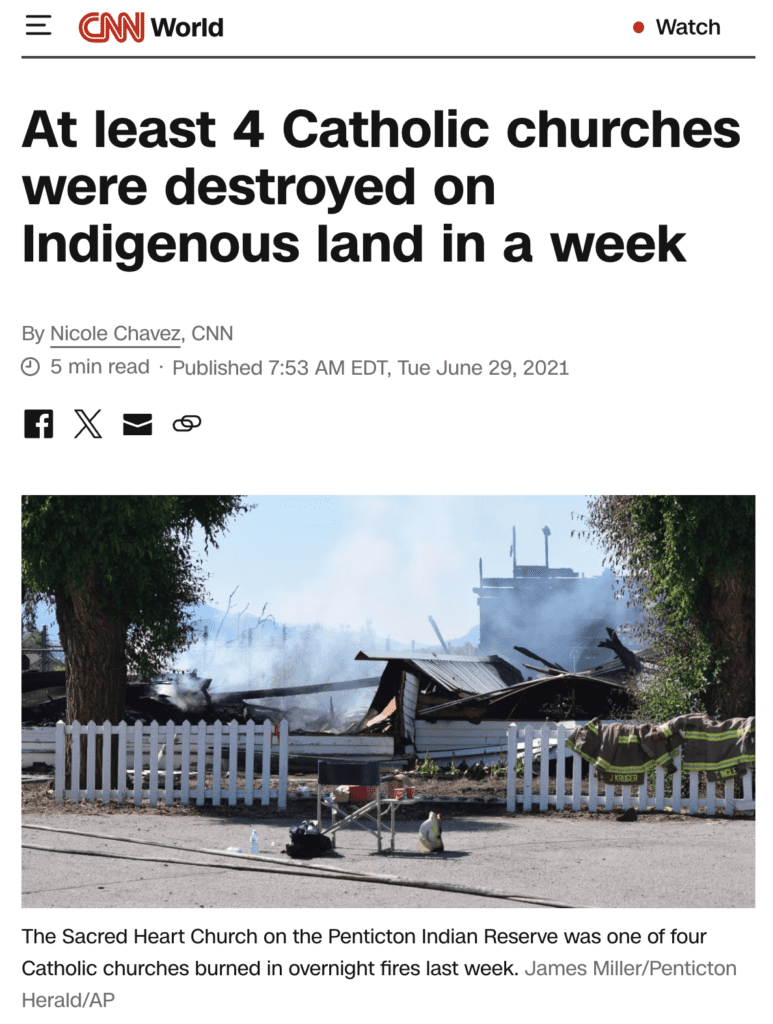
The narrative roots in woke postcolonial activism critiquing assimilation as “cultural genocide,” thereby trying to escalate it to the level of literal genocide. Again, the book From Truth Comes Reconciliation notes,
“…the use of the word “genocide” in connection with culture is a rhetorical strategy designed to impede rational discussion of the residential schools. The term “genocide” has historically been used to refer to the intentional extermination of an identifiable group of people. Adding the adjective “cultural” completely changes the meaning of the word by turning the inevitable and unstoppable processes associated with integration into a crime against humanity.” (p. 78)
If it really was an attempted systemic “genocide”, then why did the government of Canada sign treaties with the Indigenous, establish reserves, publish dictionaries of their languages, and ban relatively few indigenous traditions—such as the potlach—that actually hindered their economic progress, and never forbade Indigenous people from speaking their languages in residential schools or anywhere else? Seems like there wasn’t a systemic effort to erase Indigenous culture, but just the opposite! Now, while there may have been instances of injustice against the Indigenous by people or even politicians who discriminated against them, it is simply not true to say that it was some sort of systemic, nationally coordinated “cultural genocide” for which all of Canada is guilty.
As with other woke ideologies like Critical Race Theory (CRT) and Social Justice, it advances decolonization, emphasizing trauma to claim entitlement to reparations. The “intergenerational trauma” claim links schools to ongoing issues like addiction and poverty. However, there is a weak case for that—correlations, not causation—that ignores reserve and cultural factors. Though not the motives of every indigenous person who believes the narrative, it can become a way of sanctifying certain vices of covetousness, entitlement, laziness and resentment by adopting the Neo-Marxist framework of oppressed and oppressor classes.
Why was this myth formulated?
As with most things, there are multiple reasons behind it that vary from person to person. But there are some very important people who have used this myth for political gain. Leaders like Prime Minister Justin Trudeau benefit politically by signalling virtue and securing Indigenous votes. In his 2021 federal election campaign, Trudeau leaned heavily on the promise to right the wrongs done against indigenous Canadians. Trudeau’s 2021 flag-lowering and pledges amplified the narrative, leading to unanimous parliamentary resolutions declaring “genocide” (C2C Journal, 2023).
Governments also deflected blame onto churches, avoiding scrutiny of their own historical role. Sensational coverage generates clicks and subsidies. Canadian media, subsidized up to $29,750 per journalist (totaling $129 million over four years), aligned with the narrative, earning awards like World Press Photo of the Year (C2C Journal, 2023; Mises Institute, 2024). Outlets like CNN and CBC promoted unverified stories, benefiting from moral panic.
It has also led to funding billions of dollars into campaigns, searches, etc. $320 million federally for searches (2021-2025), and zero bodies found. Chiefs and tribal councils, such as those at Tk’emlúps te Secwépemc, receive federal grants for investigations and reparations. For instance, the Tk’emlúps band obtained $7.9 million for fieldwork and security, much of which was diverted (Mises Institute, 2024).
This positioned them as victims entitled to ongoing support, though critics argue it hinders genuine healing by fostering dependency and antipathy (C2C Journal, 2023). Building on the 2005 $5 billion settlement for 80,000 claimants, the hoax prompted Trudeau’s $40 billion pledge in 2021 for child welfare and investigations (Catholic League, 2024). This includes $238.8 million for a Missing Children Community Support Fund and $3.1 million for a Student Death Register (Mises Institute, 2024). Provinces like Ontario added $10 million for searches.
Juno News reports that,
Federal funding for “remains excavation” was initially budgeted at $7.9 million, expanded to $9.3 million, and then again to $12.1 million. The Department of Crown-Indigenous Relations had said the funds were intended for field work, DNA research, and forensics.
This was in addition to the $12 million provided by the provincial government “to support First Nations throughout B.C. with investigative work at former residential school sites.”
It seems like it would be easy to put to bed all the doubts about the claim of “mass graves” if they simply did a proper excavation and open investigation. However, after spending millions of dollars of tax payer money… the Liberal government has deemed the findings to be “confidential” information!
It sparked media sensationalism and dissent suppression via “denialism” labels, echoing cancel culture. The anti-Christian bias is central to the narrative as well—with many historic churches having been vandalized or burnt to the ground. Religiously, it spurred violence: CBC (June 26, 2024) reported 33 churches burned since 2021. Macdonald-Laurier’s study found arsons doubled (0.38% to 0.73%), totaling 112 by March 2025. Detroit Catholic (January 18, 2024) linked 68 attacks in 2021 to the narrative. Christian Post (April 28, 2025) attributes this to unproven outrage. Catholic League (June 24, 2024) notes no graves after 14 excavations, yet violence continued.
The hoax aligns with secular woke ideologies that frame Christianity as oppressive. It portrays churches as genocidal to justify attacks, eroding faith—National Review called it the “greatest hate hoax”.
The documentary, “Making a Killing” explores a lot more of the reasons behind the story (linked below).

Pursuing Truth for True Reconciliation
Now, lest anyone think that I am arguing that there were never any wrongs committed against the indiginous people by the churches involved in the Residential School System, let me be clear: there seems to have been wrongs committed and even grievous sin.
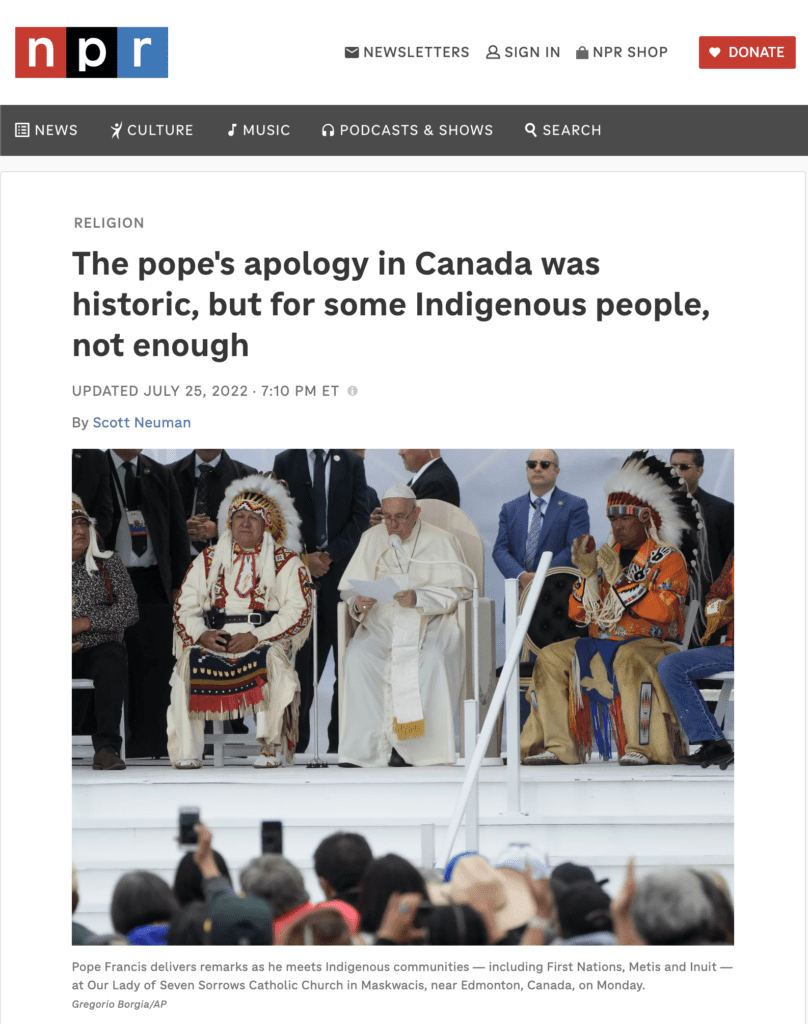
There have been substantiated accusations of sexual abuse by Catholic priests (which is not unheard of), for which Pope Francis issued an apology. The 2015 Truth and Reconciliation Commission report concluded that “[children] were abused, physically and sexually, and they died in the schools in numbers that would not have been tolerated in any school system anywhere in the country.” The Canadian Conference of Catholic Bishops wrote that, “many others speak today of far more painful memories and legacies, such as prohibitions about Aboriginal languages and cultural practices as well as cases of emotional, physical and sexual abuse.”
However, this is exactly why the false narrative about “mass graves” is so counterproductive to real reconciliation. Indigenous author Walker-Williams argued that the false “mass graves” narrative actually distracts from real abuses,
The very real trauma and damage that was inflicted resists being talked about and reported on as a consequence of the misreporting of “mass graves.” The “mass graves” story is a kind of info hazard in this regard. The discussion of it now dominates everything to do with reporting on the Indian Residential School system…
The schools were often rife with physical and sexual abuse, on top of the fact that a deliberately assimilationist objective suppressed Indigenous culture and languages…
This discourse is not a mere intellectual debate; it holds tangible, heartfelt implications. Indigenous communities, already scarred by the searing legacy of the residential schools, find their history and pain diluted. The broader public’s faith in institutions and media shudders, and the fabric of societal comprehension frays.
The fixation on the false narrative ends up taking away attention from real abuses and evils of the past that should be dealt with. However, even for these, each case must be carefully scrutinized and the evidence weighed impartially. As Christians, we’re never allowed to “just believe all victims” as today’s woke neo-Marxist culture wants to promote. We must still uphold Biblical standards of justice while we pursue real reconciliation.
The Complexity of Residential Schools
But, that also is not the end of the story.
One of the ways you know you’re speaking to an ideologue and not someone actually concerned with truth is when they cannot even consider that there may have been benefits to the Residential Schools. They cannot allow any good to be allowed into the discussion—it must simply be painted as a totally evil and corrupt endeavour, wholesale. But that is not true either.
Some good came out of the Residential Schools. Conservative Senator Lynn Beyak is quoted by the CBC as saying, “I speak partly for the record, but mostly in memory of the kindly and well-intentioned men and women and their descendants — perhaps some of us here in this chamber — whose remarkable works, good deeds and historical tales in the residential schools go unacknowledged for the most part…” She shared that she has spoken to Indigenous people who have told her of the positive experiences they had while at the schools, adding that many have kept their Christian faith after it was imparted to them by school administrators. “Mistakes were made at residential schools — in many instances, horrible mistakes that overshadowed some good things that also happened at those schools,” the senator remarked.
The truth is that the Candian Indian Residential Schools has a mottled and complex history with a legacy of both good and bad. There were grievous sins committed in some cases, but also many cases of good outcomes too. It does no one any good to either white wash the past or demonize it. We must deal with history honestly if we are to learn from it and right its wrongs.
As much as “cultural assimilation” is given a bad wrap due to the pernicious influence of multiculturalism in the whole Residential Schools debacle, there is a good argument for why it is a positive thing when done rightly and not forced upon a people group. You cannot have a united Canada in any meaningful sense if we continue to perpetuate ethnic and cultural ghettos. There is a lot of angst and division that is perpetuated when Indigenous peoples and the rest of Canadians do not integrate with each other and forfeit learning from each other.
Contrary to the secular woke ideologies that bring division in Canada, true reconciliation brings people together.
The cumulative evidence—from unexcavated sites, misrepresented GPR, disease-driven deaths, ideological biases, beneficiary gains, and devastating impacts—demonstrates the “mass graves” narrative is a lie, a modern hoax that dishonours the real sufferings of residential school survivors while fueling division and injustice. True reconciliation demands honesty: we must acknowledge past wrongs, but refuse to slander.
Sadly, many Christians, who should be the champions of truth and real reconciliation, have bought the lies and failed to think and act with Biblical standards of justice. Instead, Christians should be boldly leading the way.
Let us pray for healing, stop piling unwarranted guilt on innocent people, urge excavations for closure, and utilize our resources to reach out to and uplift Indigenous communities with the true Gospel of reconciliation. Only then can we honour the command to speak truth in love (Ephesians 4:15).